Tuesday, July 27, 2010

Past and Present

Warning: Today's post is graphic!

(As in, we only have pictures to post. Enjoy!)


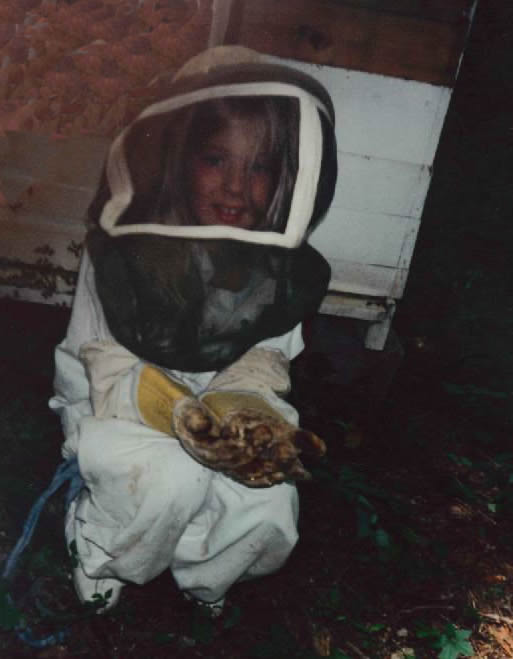
Future #1 Sales Person...


About 20 years later, still learning from the Master.


A HOT day! This is their air conditioning.

The Master at work.

Beautiful capping

Lined up like soldiers


One of the new hive locations

Also, just in case you are very observant, it is not perpetually January 2007 in our world. Our camera is calenderically challenged. :)


Monday, July 26, 2010

Back to School! (And an Update on Grafting)

The Heartland Apiculture Society's 9th Annual Conference was held July 8-10 at Tennessee Tech University. Greg attended this conference and was pleased to take sessions by Ed Holcome, Bill and Nancy Troup, Kent Williams, and many more. Some topics that were particularly interesting were Seasonal Hive Management, Hive Increase/Making Nucs, Queen Finding and Marking, and Queen Rearing. According to Greg, this was the best conference yet! He learned many new things and got to spend time with lots of beekeeping friends, like Eddie Cope and James Crockett of Pickett County and David Laferney of Putnam County.

As previously mentioned, we tried a little grafting on July 5th. We grafted 23 queen cells in one week. Greg placed the only cell that was successful in a mating hive. 4% is not too successful, but we were pleased that the one we successfully bred was from the Jennifer Barry queen. One reason for this low rate of success could be attributed to the fact that Greg doesn't like to do things by the book. :) Often he has found that he learns more by fumbling around and trying things (or rather is FORCED to learn more BECAUSE of fumbling around). But live an learn, right?


So grafting round two... On July 14th, Greg and David Laferney tried again, grafting 30 larva. David furnished the starter hive: one running over with bees with no queen. Greg provided the larva from the Barry queen. On the 16th, we determined that we had about a 50% success rate! This weekend Greg installed the cells in mating nucs. We will wait to see the results of that.


One more update pertains to one of our new friends we have mentioned a couple of times in this blog, Dwight Johnson. Greg went to check on him and his bees on July 16th; because of his hard work and dedication, he has been given an A+ in bee keeping from Greg Holt, Ph. Bee.

Thursday, July 8, 2010

Grafting Again

Earlier this week, Greg decided to give grafting another shot (we have had fair success with this for producing extra queens). He started at the Jennifer Berry hive, since they have settled in nicely and currently are the best performing queens we have. He pulled a frame of eggs, or brood, and took it to the bee lair (or the basement, as laymen may call it). He grafted 23 larva into the prepared plastic cups (fake queen cells) and then installed the cups in a queen-less upper hive body that he had made by shaking all of the bees in the front of the hive and installing a queen excluder underneath, so that only the worker bees can go into the second story.


This is a queen cell (looks like a peanut with a hole in the top). Pic is courtesy of this site.

This is a plastic queen cup. Pic is courtesy of this site.

The queen-less hive body contains brood. The idea is to keep the queen in the lower hive body performing as usual, while in the top hive body, the nurse bees will consider themselves queen-less because of the excluder. Then they should proceed to make queens from the grafted larva.

In about 8-10 days, Greg plans to retrieve the queen cells and place them in a mating hive, which is a small hive prepared for this purpose with one frame of bees and food (like a honeymoon suite, if you will). We will see what kind of success we have this time.

We don't need an abundance of queens, yet it would be nice to have a supply ready to replace old or poorly performing queens before the weather starts getting cold. It would be extra nice to have a few extra to share or sell (Probably only to local buyers...cheapqueens.com turned out to be a bad idea).

Greg has begun robbing and is spreading the harvest out over the month of July. The honey, of course, is the best we've ever had. Yet, we have never experienced a year where it WASN'T the best we've ever had. For the record, it is always a true statement.

In other apiary news, we have located two new hives to Crossville, TN. We hope that the higher elevation will yield some sour wood honey, famous in that part of the region. If that is successful, we will begin looking for a location for more elaborate extension to the east.

Tuesday, June 29, 2010

SWARM!


As Greg arrived home from town last week, he saw the biggest swarm he had ever seen. It looked as though all of the bees were making a run for it! The air was FILLED with bees. He watched it for about a half hour until it finely landed about 40 feet up in a red oak, much too high for a wise man to even think about going after it.

(You can see where this story is going...)


It only took a little encouragement from James to get Greg up on the ladder with the saw. Once the cut was complete, the bees decided to test Greg once more by going even HIGHER! They settled nicely about 75 feet up in the tree and closed shop for the night.

It sure would have been nice to hive them, since there were probably fifteen pounds of bees on the loose, enough to fill a wash tub halfway. But that is how it goes. Greg says maybe next time. Bean says maybe next time he will stay out of the trees.

Friday, June 18, 2010

Getting "Laid"

Sorry to get your hopes us, but the only thing risqué about this post is the title. Bee keeping is sexy, right? Anyways, this post is about a laying worker, which is a death sentence for the hive.

While checking the White County apiary, Greg noticed that the activity at the entrance of the hive was not right. An experienced bee keeper knows that you don't even have to look in a hive sometimes to know something is wrong. Often times you can tell as much about a hive from watching the entrance as you can from a full hive inspection. After a look inside, a laying worker seemed to be the culprit of this misbehaving hive. Perhaps the queen died, or swarmed and didn't take everyone with her, but she was gone and a worker bee had taken her place. Only a queen bee is able to lay fertilized eggs (which will make worker bees) so a laying worker means that all the baby bees are male or drones (which means they just lay around sitting on bean bag chairs, eating cheetos all day) :).

Just an aside, if you are wondering what makes a queen different than a regular worker bee is how long the bees feed her royal jelly. All bees begin the same and the amount of days they are fed royal jelly (which is a substance secreted from the head of the bees, akin to nursing) decides their role in the hive.

To remedy this situation, a frame with eggs and young brood was placed inside the hive. With any luck, the bees will decide to make a queen from one of these cells. Sometimes this solution works and sometimes it doesn't. Generally nature has a better way to fix things, so it is just a bee keeper's job to nurture the bees and give them resources to make them successful (like with having kids!). Often the best thing we can do is get out of way and let mother nature work.

We will follow up with this hive soon. Our historic losses on this problem are pretty high, so we will see if the "less is better" option works out for us. So in this case, we are really more concerned about who is doing the laying rather than who is getting "laid". They don't call it the "birds and the bees" for nothin'.
"Queen" of the Hill

Last week we received two new queens from Jennifer Barry (via Brushy Mountain). We were very proud to receive them because of their good stock and reputation. We think it is a good investment despite the price tag. We took enough frames of drawn out comb and brood from six different good performing hives to make nucs for the two queens. We did this on Wednesday. On Saturday, Greg checked on the queens to remove the cages. On Monday, he checked one of the host nucs and found several queens cells. We suspect that we accidentally took one of the old queens from one of the six hives with us to the new nuc. There was no need to panic, as Greg had a five frame nuc ready to be a home for one of the queen cells. He moved that nuc out to the Smith Apiary and can use that nuc as an emergency replacement or to help prevent late season swarming.


Tuesday, James and Greg checked on the two new nucs and all seems to be well. We thought that the host queen was killed by the new "Jennifer" queen, but it turns out that we didn't move the host queen. She was still creating some queen cells in her own hive, which meant they are thinking about swarming. So we put the extra queen cells in the queen castle to harvest those queens to replace old or ill performing queens. We also put two more queen cells and a frame for each into two separate apartments in the queen castle. Two good queen cells were left in the host hive for requeening. We will keep you updated on these queens soon.


Monday, June 7, 2010

From Mistakes to Double Takes

Double screen wire that is! This entry was inspired by a loyal follower, Steven C., who keeps us on our toes. Jessie made a typo in the last post and shook up the bee keeping community with the elusive "bubble" screen method. Whoops! (A lot of good an English degree did her editing skills!)

Anyways, we decided to make a teachable moment out of our mistake and talk a little about the double screen method, the why's and hows' to this technique.

First, use a double screen 3/4" frame with #8 wire in both sides with one entrance on top side of one end . Find the queen put her in the lower box with capped brood and pollen/honey. Place the eggs and open brood in the top with some honey and pollen and either a queen cell, caged queen or let them make their own queen. Place the screen between them with the entrance in rear . The virgin queen will use this entrance for her suiters. :)

In about 30 days look and see if you like the egg pattern of the new queen. If so, you have some options: kill the old queen, move her to a bank for emergence replacements, or just take your chances and put the two boxes together. If you do this, the new queen will most likely kill the old, but you never know. Use a newspaper combine for the two boxes . With this method the hive will think it swarmed and will not swarm. Use this method to requeen cheaply and easily while having the advantage of two queens laying eggs for a while and end up with a strong hive for honey production. You can also use as a split and move the top hive to a new location for replacement of winter losses.

If you have questions or comments or stories to share about your own tips and tricks, please post them in the comments area. We will try to be a little more careful about our typos, but thought it was a good opportunity to do a little explanation. Wishing you all a honey filled summer!